


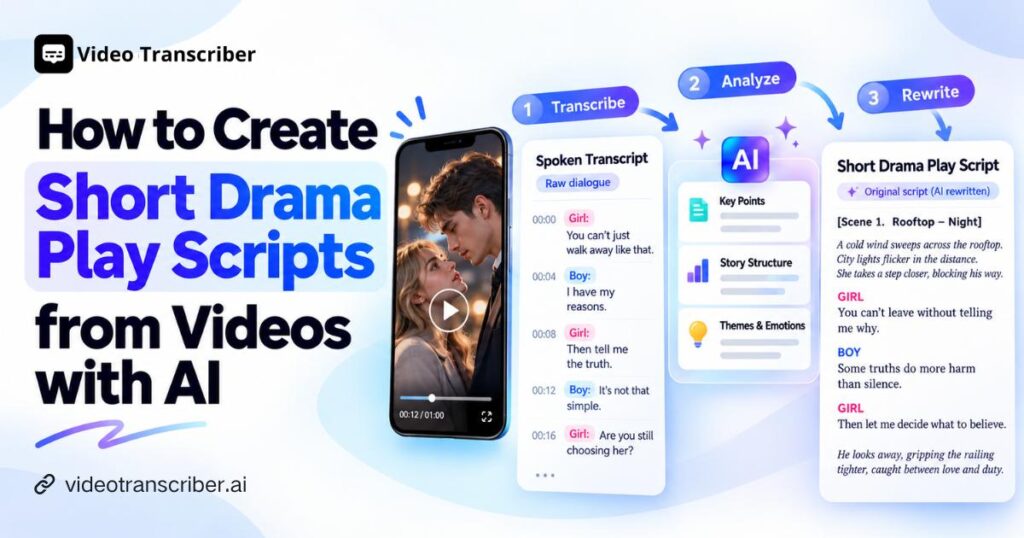
Smartphones have become an everyday screen for stories, and vertical dramas are finding a huge audience. According to Sensor Tower's State of Short Drama Apps 2026 report, global short drama app downloads exceeded 850 million in the first quarter of 2026, up 140% year over year. Omdia estimates the global microdrama market generated $11 billion in revenue in 2025.
Platforms such as ReelShort and DramaBox have pushed short-form storytelling into the mainstream, but a crowded market makes it harder to write short drama play scripts that win attention in the first few seconds.
Instead of starting from a blank page, creators can study existing stories as text. When you transcribe video to text, every line of dialogue becomes searchable and easy to annotate. This guide shows how to create short drama play scripts by turning video transcripts into storytelling insights, then using those insights to write original short drama play scripts.
What Are Short Drama Play Scripts?
Short drama play scripts are written frameworks for dramatic stories that unfold in a limited time. They include characters, dialogue, scene descriptions, actions, and the conflicts that drive the story forward.
Unlike feature screenplays, short drama play scripts must establish their central situation fast: a surprising accusation, an unexpected reunion, or a secret revealed in an ordinary conversation. Stage plays and mobile microdramas follow different production conventions, yet both rely on clear structure, from the opening hook and central conflict to a turning point and an ending or cliffhanger.
The challenge in short drama play scripts is not using fewer words. It is making every scene count. One conversation may need to establish a relationship, expose a hidden motive, and set up a turning point, which is why video transcripts make such useful study material.
Why Use Video Transcripts to Study Short Drama Play Scripts?
Watching a gripping drama is easy. Understanding why it works is harder, because the techniques behind a confrontation or plot twist are difficult to study while the video keeps playing.
Short drama transcription solves this. Spoken conversation becomes searchable, editable text, so instead of replaying a whole episode, creators can revisit particular exchanges and compare scenes. For writers who want better short drama play scripts, this turns passive viewing into active analysis.
A transcript is not a finished set of short drama play scripts, though. Facial expressions, camera movement, music, and silent actions are missing, so combine transcript analysis with the original video. When studying short drama play scripts, the goal is to understand storytelling principles, not to copy scenes.
How to Transcribe Short Drama Videos with AI
The first step toward studying short drama play scripts is converting dialogue into a structured transcript. Manual work is slow when speakers overlap or talk fast. A video transcript generator removes that bottleneck and leaves more time for analysis.
Step 1. Choose and Prepare a Short Drama Video
Pick a drama that shows a technique you want to use in your short drama play scripts, such as a strong hook or a surprise ending, and start with a self-contained scene that has few characters.
If your research involves ReelShort or DramaBox content, use video files you created, licensed, or have permission to use. Availability on a platform does not grant the right to download, reproduce, or republish protected material. Before you transcribe short drama content, prefer recordings with clear dialogue and little background noise.

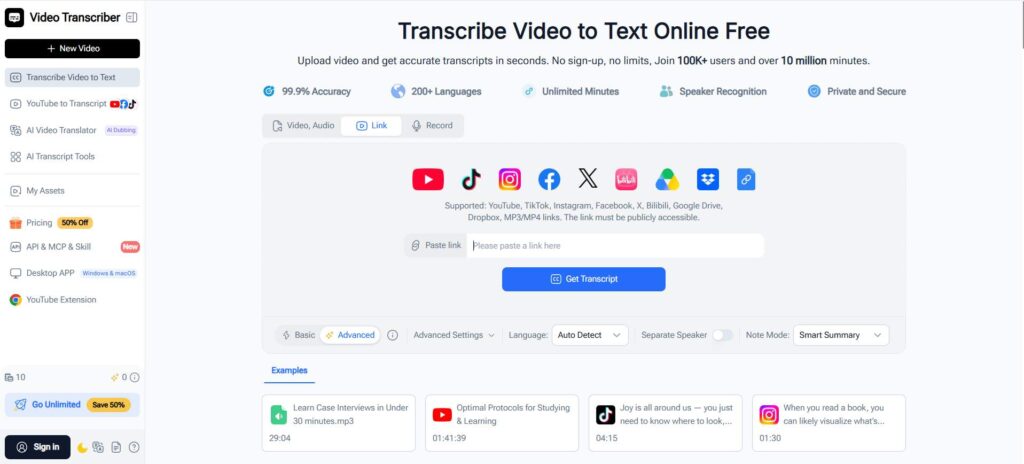
Step 2. Upload and Transcribe Short Drama Dialogue
To transcribe video to text, open Video Transcriber AI and upload the file to build the text base for your short drama play scripts. It supports video-to-text workflows with multilingual transcription, speaker recognition, timestamps, and online transcript editing. Its advanced option adds word-level timestamps and better handling of difficult speech.
A practical short drama transcription workflow looks like this:
- Upload a supported video file containing the drama scene.
- Choose a transcription option and start processing.
- Review the transcript against the recording.
- Correct character names, dialogue errors, and unclear lines.
- Save the transcript for analysis and script development.
This video to script preparation creates a reliable record of what characters actually say. One wrong word can change a scene, and words of hesitation, denial, or accusation often carry the conflict. Anyone who needs to transcribe short drama video files regularly should double-check names, emotional statements, and interrupted lines. The same checks apply to ReelShort transcription of clips you are permitted to use.
Step 3. Organize Speakers, Dialogue, and Key Scenes
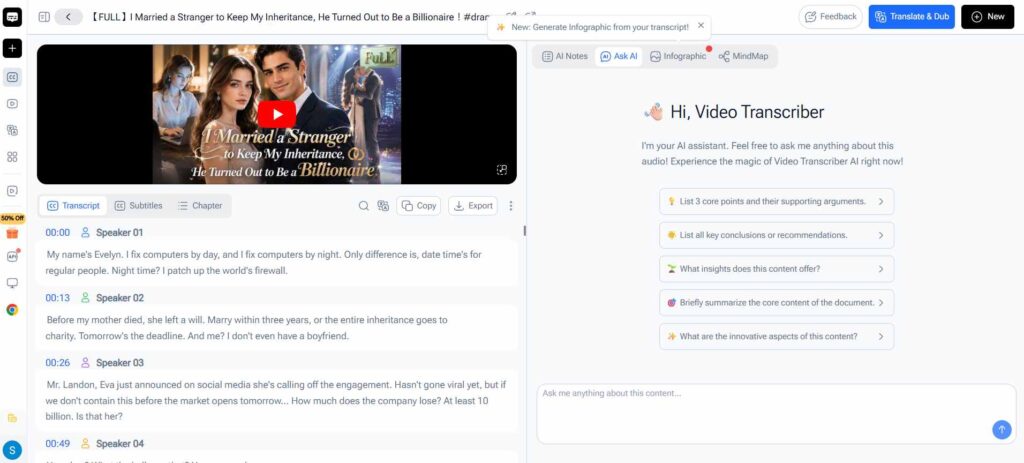
Speaker recognition separates dialogue by participant, and timestamps help you find moments in the recording.
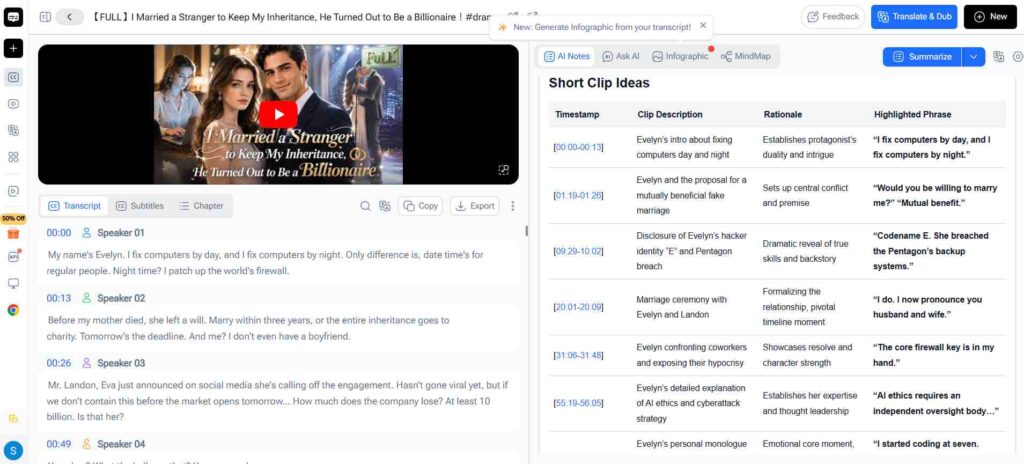
Video Transcriber AI also offers transcript search, highlighting, AI summaries, and AI Chat, so you can search repeated phrases, highlight escalating conflict, or ask AI to summarize a conversation. Divide the transcript by changes in the dramatic situation rather than arbitrary time intervals. This lets writers read short drama play scripts as connected narratives instead of isolated lines.
How to Analyze Short Drama Play Scripts Using Video Transcripts
Creators studying short drama play scripts should look beyond what characters say and ask why each exchange matters.
Identify Structure, Conflict, and Plot Twists
Even a short scene follows a progression: a situation is established, tension rises, and new information forces a response. Ask what each important line changes. Consider an original fictional exchange:
EMMA: You promised me the promotion. DANIEL: Things have changed. EMMA: Then why is my name on the resignation letter you prepared yesterday?
The first line establishes a disagreement, the second creates uncertainty, and the third raises the stakes. With only three lines, it is a useful model for studying short drama play scripts.
In AI Chat, a creator might ask: Identify the initial conflict, escalation, and turning point in this dialogue. Verify the answer against the transcript and video rather than accepting every inference.
Analyze Character Relationships and Dialogue
Effective short drama play scripts reveal personality through decisions, reactions, and dialogue, not explanatory narration. Emma seems frustrated and suspicious, while Daniel avoids explaining. A transcript shows what characters say, but their motivations remain interpretation.
Writers can examine how characters interrupt, dodge questions, or change tone, and use AI to find where cooperation turns into confrontation. These patterns help creators write short drama play scripts in which conversations advance the story instead of filling screen time.
Understand Pacing, Emotional Hooks, and Cliffhangers
According to Sensor Tower's 2026 report, average daily time spent in short drama apps reached roughly 25 minutes by April 2026. That shows the appeal of serialized, mobile-first entertainment, though it does not prove that any writing technique keeps viewers watching.
When studying short drama play scripts, examine where information is withheld, when conflict intensifies, and which question remains open at the end. Pacing also depends on pauses, expressions, and editing, so check transcript-based findings against the original video.
How to Turn Video Transcripts into Original Short Drama Play Scripts
Once the analysis is done, creators can move from studying existing content to developing original material. This is where a video transcript to script workflow pays off: instead of asking AI to reproduce an episode, writers apply general techniques to a new story.
Step 1. Extract a Reusable Framework for Short Drama Play Scripts
Summarize the dramatic structure without the original characters, dialogue, or distinctive plot details. The workplace scene above reduces to a broad pattern: a character expects a reward, discovers a betrayal, and challenges someone who controls their future. For short drama play scripts, the key skill is separating general principles from original expression.
Step 2. Reimagine Characters, Settings, and Conflicts
Develop a genuinely different premise rather than changing names. For instance, two siblings could compete over the future of a family bookstore, one proposing to sell the building while the other believes the business can be saved. New relationships and stakes follow, and your short drama play scripts stand on their own motivations.
Step 3. Rewrite Dialogue and Develop New Scenes
An AI drama script generator can produce starting drafts of short drama play scripts, but good dialogue needs human revision. Ask whether characters sound natural and whether each exchange adds useful information. In short drama play scripts, not every line must be an exaggerated declaration.
Step 4. Format and Refine Your Short Drama Play Scripts
Arrange the material into scene headings, character names, dialogue, and action descriptions. Review your short drama play scripts for continuity, originality, and production needs.
Short Drama Script Examples: From Transcript to Original Script
This example shows how short drama play scripts can apply three principles from the analysis: begin with a broken expectation, reveal an imbalance of power, and add information that changes the conflict. The story is new, set in a neighborhood bookstore facing closure.
Title: The Last Book on the Shelf
Characters: MAYA, a determined bookstore owner; LEO, her younger brother.
INT. BOOKSTORE, NIGHT
Half-empty shelves line the walls. MAYA reviews invoices as LEO enters carrying a folder.
LEO: We need to talk about the building. The sale has already been approved.
MAYA: By whom? Mom left the store to both of us.
LEO places a document on the counter. MAYA opens the folder, and a handwritten note falls out.
MAYA: This isn't her signature.
LEO: Then who signed it?
From the locked office at the back, a phone starts ringing.
END SCENE
The sample reuses one principle, an expectation disrupted by a revelation, with different characters and dialogue. Among short drama script examples, the useful ones teach technique. In short drama play scripts, research should reveal possibilities, not duplicate finished stories.
Useful AI Prompts for Short Drama Transcription and Short Drama Play Scripts
Prompts work better when they name the task, source material, and expected output. After short drama transcription, try these in Video Transcriber AI's AI Chat:
| Creative Task | Example AI Prompt |
| Story analysis | Identify the central conflict, character goals, turning points, and unresolved questions in this transcript. |
| Original story development | Extract broad storytelling principles, then propose three substantially original premises. |
| Script drafting | Using my new premise and character outline, write a three-minute drama script with natural dialogue. |
Separate the analytical prompt from the creative one: first ask AI to explain what happens in the source, then supply a new premise and request an original script. This lowers the risk of reproducing distinctive dialogue and helps turn rough ideas into structured short drama play scripts.

Tips for Creating Better Short Drama Play Scripts
Learning from existing content helps, but strong short drama play scripts still need judgment, originality, and revision.
Prioritize meaningful conflict. In short drama play scripts, a confrontation matters when characters have clear goals and something to lose.
Make dialogue do several jobs. Good exchanges reveal personality, change relationships, and advance events at once.
Respect originality and source rights. Studying public content does not authorize copying protected dialogue or distinctive scenes. Write substantially independent short drama play scripts.
AI can help organize ideas, but it cannot replace your grasp of audience expectations and emotional authenticity.
Frequently Asked Questions
Can AI analyze a short drama from its video transcript?
Yes. AI can examine a transcript for dialogue patterns, relationships, conflicts, and story progression, which supports research into short drama play scripts.
How do I turn a video transcript into a drama script?
Transcribe the video, identify speakers and key dialogue, then organize the text into dramatic beats. To create original short drama play scripts, design new characters, settings, and conflicts before writing new dialogue. Human review remains essential.
Can I use AI to create an original script inspired by an existing drama?
Yes, if you learn from general narrative principles instead of reproducing protected dialogue or story elements. Original short drama play scripts should carry their own creative expression.
Conclusion
Strong storytelling still depends on characters, conflict, dialogue, and audience expectations. Video transcripts offer a practical way to study short drama play scripts. With Video Transcriber AI, creators can use this video transcript generator to transcribe dialogue, review key scenes, analyze narrative techniques, and develop original ideas.
The goal is not simply to produce short drama play scripts faster. It is to understand how stories work and write short drama play scripts worth watching. Start with a video you have permission to use, examine its storytelling choices, and turn what you learn into something new.