


Transcription in qualitative research is the process of converting recorded interviews, focus groups, observations, or other spoken data into written text for analysis. It is not a neutral copy of a conversation. Choices about speakers, pauses, filler words, overlap, punctuation, and anonymization affect what researchers can later code and interpret.
The best transcript is not necessarily the most detailed one. It is the transcript that fits the research question, preserves the evidence needed for analysis, protects participants, and lets researchers return to the original recording when necessary.
Key Takeaways
| Question | Short answer |
| Is verbatim transcription always required? | No. The appropriate detail depends on the research question and analytical method. |
| Can researchers use AI transcription? | Yes, when consent and institutional rules permit it. Treat AI output as a first draft. |
| What makes a transcript research-ready? | Consistent rules, correct speakers, checked terminology, useful timestamps, and protected identities. |
| What is a practical workflow? | Define the protocol, create a draft, check it against the recording, anonymize it, and then begin coding. |
What Is Transcription in Qualitative Research?
Qualitative data may come from semi-structured interviews, focus groups, online meetings, video diaries, or recorded observations. Transcription makes that material searchable, comparable, codable, and quotable.
A recording may also contain tone, pace, gesture, background activity, and overlapping speech. No transcript preserves everything. The researcher decides which features matter and how they will appear on the page. For that reason, transcription is part of analysis rather than a purely administrative step.
Transcript vs. captions vs. subtitles
| Format | Main purpose | Typical features |
| Research transcript | Analysis and evidence | Speakers, context, timestamps, anonymization |
| Captions | Accessible viewing | Short synchronized segments and sound descriptions |
| Subtitles | Translation or on-screen dialogue | Concise timed text optimized for reading |
Captions can provide a first draft, but they may not contain the speaker identification, contextual detail, or privacy treatment required for research.
Why Transcription Choices Matter
Consider the sentence, “I didn’t say she took the file.” Stressing “I,” “say,” “she,” or “file” changes the meaning even though the words remain identical. A plain transcript cannot show that distinction unless emphasis is marked.
The same applies to pauses, laughter, hesitation, interruptions, and self-correction. These features may not matter in a basic content analysis, but they can be essential in conversation analysis or research into identity, power, and interaction.
The practical rule is simple: decide how the data will be analyzed before choosing how it should be transcribed.
Types of Transcription in Qualitative Research
Terms such as “verbatim” are not always used consistently. Define the selected convention in the research protocol instead of relying on the label alone.
| Type | What it preserves | Common use |
| Full verbatim | Words, fillers, repetitions, false starts, and relevant sounds | Interviews, focus groups, discourse-oriented studies |
| Clean verbatim | Meaning and sentence structure, with routine disfluencies removed | Thematic and qualitative content analysis |
| Edited transcription | Main meaning in polished language | Accessible summaries or publication extracts, not usually the primary record |
| Jeffersonian | Timed pauses, overlap, stress, volume, cut-offs, and speech rate | Conversation analysis |
| Selective transcription | Only material covered by a documented selection rule | Large or narrowly focused datasets |
Full verbatim preserves more options for later analysis but takes longer to review. Clean verbatim is easier to read, yet cleaning should never change a participant’s meaning or rewrite dialect simply to sound more formal. Jeffersonian transcription captures interaction in depth and generally requires intensive human listening even when AI creates the first draft.
Which Method Should You Choose?
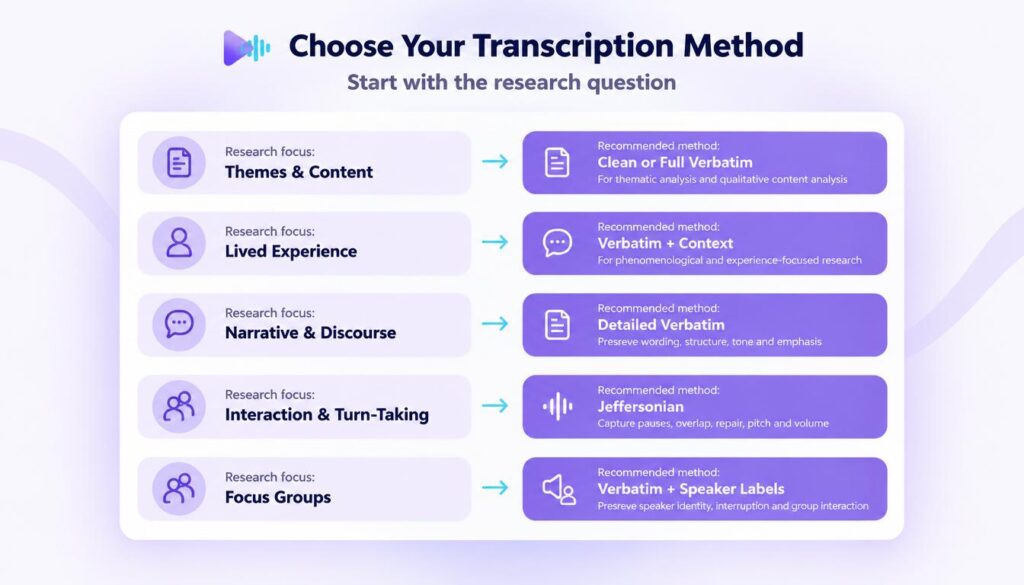
The following options are starting points, not fixed rules.
| Research approach | Suggested starting point | Important details |
| Thematic analysis | Full or clean verbatim | Participant wording and context around coded passages |
| Content analysis | Clean or standard verbatim | Consistent units and formatting |
| Grounded theory | Verbatim | Participant language and emerging concepts |
| Phenomenological analysis | Verbatim with contextual notes | Expressions of experience, pauses, and emphasis |
| Narrative analysis | Verbatim or detailed transcription | Story structure, sequence, wording, and tone |
| Discourse analysis | Detailed verbatim | Language choices, framing, hesitation, and emphasis |
| Conversation analysis | Jeffersonian | Turn-taking, pauses, overlap, repair, pitch, and volume |
| Focus groups | Verbatim with clear speaker labels | Agreement, interruption, overlap, and group dynamics |
If the team is uncertain, preserve more information in the first transcript and create a cleaner copy later.
A Practical Transcription Workflow
| Step | What to do |
| 1. Define the protocol | Specify the transcript type, speakers, timestamps, contextual markers, anonymization rules, and review process. |
| 2. Confirm permission | Check participant consent, ethics approval, institutional policy, and rules for third-party or AI processing. |
| 3. Prepare the files | Use non-identifying file names, preserve the original recording, and record essential metadata. |
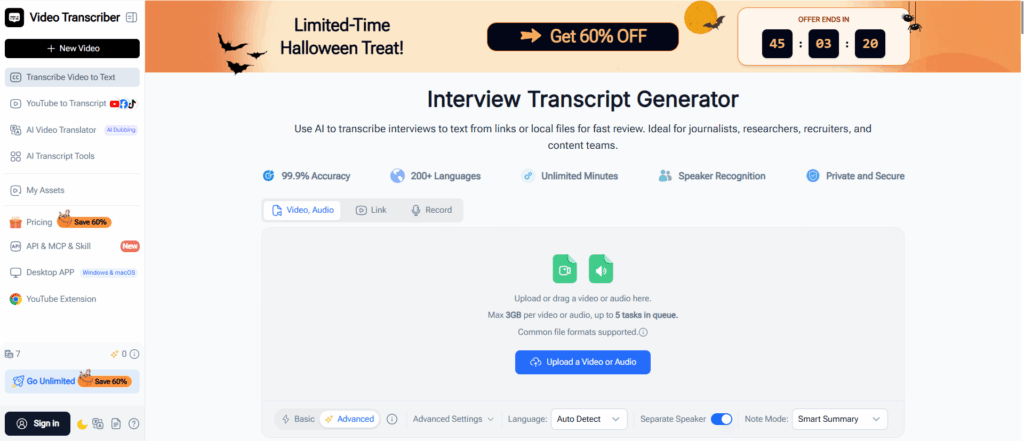
| 4. Create the draft | Transcribe manually, use a professional service, generate an AI draft, or combine these approaches. |
| 5. Add speakers and timestamps | Apply stable labels and make important passages traceable to the recording. |
| 6. Review the transcript | Check speakers, negatives, dates, numbers, proper names, specialist terms, and unclear audio. |
| 7. Protect identities | Replace direct identifiers and assess combinations of indirect details that could reveal a participant. |
| 8. Document the process | Record who transcribed, which convention was used, how checking was done, and how data was protected. |
Consent to recording does not automatically permit uploading data to an external AI service. Confirm the approved data-handling rules before selecting a tool.
Manual vs. AI Transcription
| Method | Main advantage | Main limitation | Best fit |
| Manual | Close engagement with the recording | Slow and affected by fatigue | Small datasets or detailed notation |
| Professional human | Saves researcher time and can follow a protocol | Cost and confidentiality management | Funded projects with an approved vendor |
| AI | Fast, searchable first draft | Errors in difficult audio and limited contextual judgment | Clear recordings with human review |
| Hybrid | Combines speed with researcher control | Still requires planned checking | Most interview projects where AI is permitted |
A hybrid workflow is often practical: generate a first draft, correct it against the recording, apply the chosen convention, anonymize it, and verify every passage used as evidence.
AI summaries and chat functions can help researchers navigate a long recording. They should not replace formal coding or reflexive analysis. A generated theme may reflect the system’s assumptions rather than the study’s analytical framework.
A 7-Point Quality Check
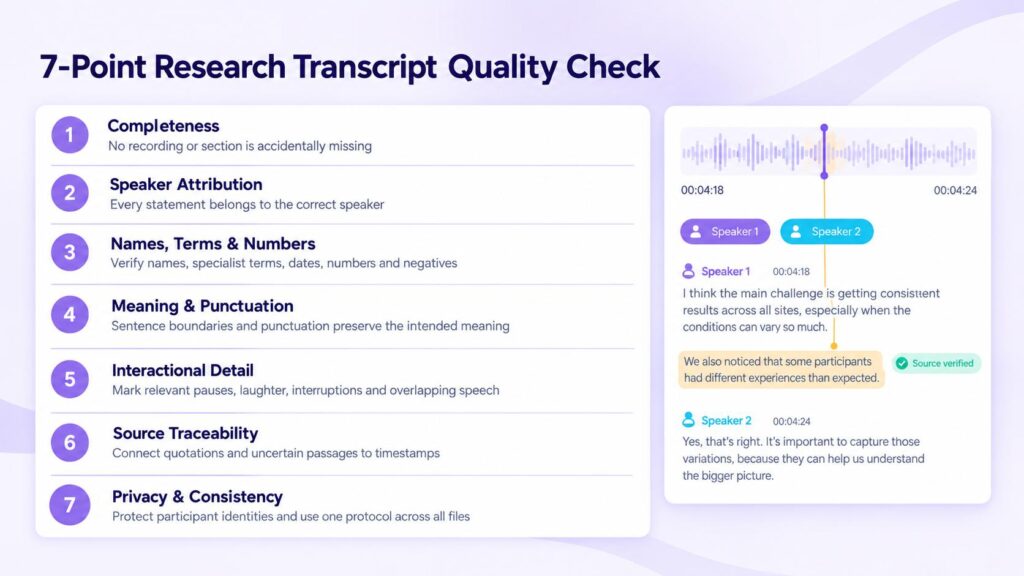
Accuracy is not a single percentage. A mostly correct transcript can still be analytically misleading or unsafe.
| Check | What to verify |
| 1. Completeness | No recording or section is accidentally missing |
| 2. Speaker attribution | Each statement belongs to the correct person |
| 3. Key details | Names, specialist terms, dates, numbers, and negatives are correct |
| 4. Meaning | Punctuation and sentence boundaries reflect the recording |
| 5. Interaction | Relevant pauses, laughter, overlap, and nonverbal events are marked |
| 6. Traceability | Quotations and uncertain passages can be found through timestamps |
| 7. Privacy and consistency | Identifiers are handled correctly and one convention is used across files |
Record the reviewer, date, and status of each transcript. Always recheck published quotations, sensitive statements, and evidence central to a theme.
Ethics, Privacy, and Confidentiality
Qualitative recordings can contain sensitive information about participants and third parties. Searchable transcripts therefore require careful access control.
Before using an AI or external service, establish:
| Question | What the team should confirm |
| Was the processing covered by consent? | Participants received an accurate explanation of recording and transcription |
| Does the institution permit the service? | The workflow matches ethics and information-governance requirements |
| Where is data processed and stored? | Locations, retention, deletion, and access controls are understood |
| Is data used for model training? | The service terms and settings match the research protocol |
| Who can access the files? | Only authorized people and accounts have access |
| How will files be deleted? | The retention schedule covers recordings, drafts, exports, and backups |
De-identification removes explicit identifiers. Anonymization aims to prevent identification and may require generalizing combinations of details. The terms should not be used as synonyms.
Transcript Format Example
Study ID: QLR-2026-04
Interview ID: P07
Transcript type: Full verbatim

[00:04:18] Researcher:
What changed after the new process was introduced?

[00:04:24] Participant 07:
At first, I thought it would save time, but [pause] it actually
created more work for our team.
Use clear markers such as [inaudible 00:12:48], [laughter], [overlapping speech], and [participant name]. Never invent an uncertain word to make the transcript appear complete.
Working With Lectures, Study Materials, and Podcasts
Researchers also work with methods lectures, webinars, and public audiovisual sources. For recorded classes, an AI lecture note taker can create searchable notes linked to important moments. Use the notes for review, not as a substitute for the original source.
A study notes generator can organize educational recordings into summaries, notes, or mind maps. Keep these learning materials separate from the formal analysis of participant data.
For a public podcast, panel, or archived interview, a podcast-to-transcript converter can create a draft with speakers and timestamps. Confirm copyright, ethics, sampling logic, and quotation accuracy before using public media as research evidence.
Common Mistakes
| Mistake | Better practice |
| Using “verbatim” without defining it | State which verbal and nonverbal features were retained |
| Choosing maximum detail by default | Match detail to the research question |
| Cleaning dialect or grammar | Preserve participant voice and meaning |
| Accepting AI speaker labels | Verify multi-speaker passages against the recording |
| Treating an AI summary as analysis | Use it for navigation, not final interpretation |
| Quoting unchecked text | Recheck every published quotation |
| Hiding the process | Report transcription, review, and anonymization in the Methods section |
Example Methods Statement
Interviews were recorded with participant consent and transcribed using [full verbatim/clean verbatim] conventions. A first draft produced by [the researcher/a professional transcriber/an automated system] was reviewed against the original recording by [role]. Speaker attribution, names, specialist terms, numbers, and unclear passages were checked. Direct identifiers were replaced before coding, and final transcripts were analyzed using [method or software].
Only report procedures that were actually completed.
Frequently Asked Questions
What is transcription in qualitative research?
It converts recorded speech or audiovisual interaction into written data and requires decisions about speakers, pauses, overlap, emphasis, and nonverbal events.
Do qualitative interviews have to be transcribed verbatim?
No. Thematic analysis may use full or clean verbatim, while conversation analysis normally needs detailed interactional notation.
Can AI transcribe qualitative interviews?
Yes, when consent, institutional policy, ethics approval, and data-protection rules permit it. Treat the result as a draft and verify important passages.
How do researchers check transcript accuracy?
Compare the transcript with the recording, verify speakers and key terms, mark uncertainty, confirm quotations, and apply one protocol across the dataset.
Should filler words and pauses be included?
Include them when relevant to the research question or method. Clean verbatim may remove routine fillers when the study focuses on content.
How should transcripts be anonymized?
Replace direct and indirect identifiers, use clear placeholders, and store the identity key separately. Remember that contextual details may still reveal a participant.