


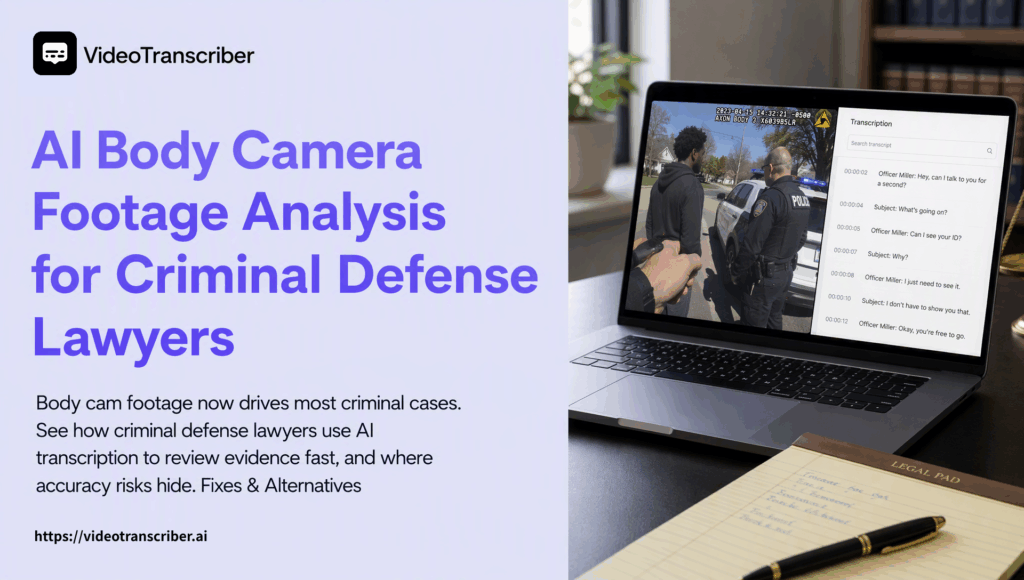
Digital evidence isn't a side issue in criminal defense anymore, it's the case. A single serious charge can now generate dozens of hours of body-worn camera (BWC) footage, and defense teams are expected to review all of it on the same tight discovery timelines that existed before cameras were standard-issue gear. AI-assisted review tools have moved into that gap quickly, but the tools themselves come with tradeoffs that rarely make it into the marketing copy. This guide breaks down what AI can and can't reliably do with body camera footage, where the accuracy and ethics risks actually sit, and how to build a review workflow that holds up in court.
Why Body Camera Footage Has Become the Biggest Bottleneck in Criminal Defense
The volume problem is not anecdotal. One county-level prosecutor's office in Colorado received more than 67,000 videos in 2025, totaling roughly 42,000 hours of footage, an 83% increase in just three years, driven largely by mandatory body camera rollouts across the state's roughly 14,000 officers (CBS News Colorado). Defense counsel, especially public defenders, are absorbing the same volume increase without a corresponding increase in staff or hours in the day.
| Metric | Figure | Source |
| Criminal cases involving video evidence | Over 80% | Bureau of Justice Statistics data, via MIT Solve |
| Public defenders nationwide | ~15,000, serving 5.6M+ low-income clients annually | MIT Solve / JusticeText |
| Felony defendants relying on public counsel | Over 80% (largest U.S. counties) | 2015 Bureau of Justice Statistics study |
| Average footage per officer per month | ~32 files, ~7 hours, ~20GB (720p) | TechCrunch reporting on JusticeText |
| Public defender caseloads vs. recommended standards | 3–10x recommended limits | TechCrunch reporting on JusticeText |
| Colorado First Judicial District video volume, 2025 | 67,000+ videos / ~42,000 hours | CBS News Colorado |
Multiply an average officer's monthly footage across a department with hundreds of officers, and it's easy to see why manual review is no longer physically possible within standard case timelines. This is the actual reason AI-assisted review took hold first among public defenders rather than as a general legal-tech trend, the caseload math simply stopped working.
What AI Can Actually Do With Body Camera Footage
Most AI-assisted BWC tools perform a narrower set of tasks than "AI evidence analysis" branding suggests. In practice, the functionality that has proven useful in real public defender offices includes:
- Automated transcription of audio tracks, making footage full-text searchable instead of requiring a scrub-through
- Timestamp flagging of specific moments, Miranda warnings, arrest declarations, requests for counsel
- Cross-file comparison to surface inconsistencies between an officer's report and what the footage actually shows
- Clip generation for building court exhibits without re-editing raw video files
Kentucky's Department of Public Advocacy adopted JusticeText specifically to manage a surge in bodycam-related discovery, and reported meaningful reductions in review time per case, though funding constraints meant the tool wasn't available to every defender statewide. Santa Cruz County's public defender's office reported similar time savings after adopting the same platform, while Colorado's State Public Defender office uses Reduct.Video to transcribe interrogation footage and generate court-ready clips and captions.
These are real, documented gains. But every one of them depends on the underlying transcription being accurate, and that's where the harder conversation starts.
Pain Point #1: Accuracy Isn't Evenly Distributed
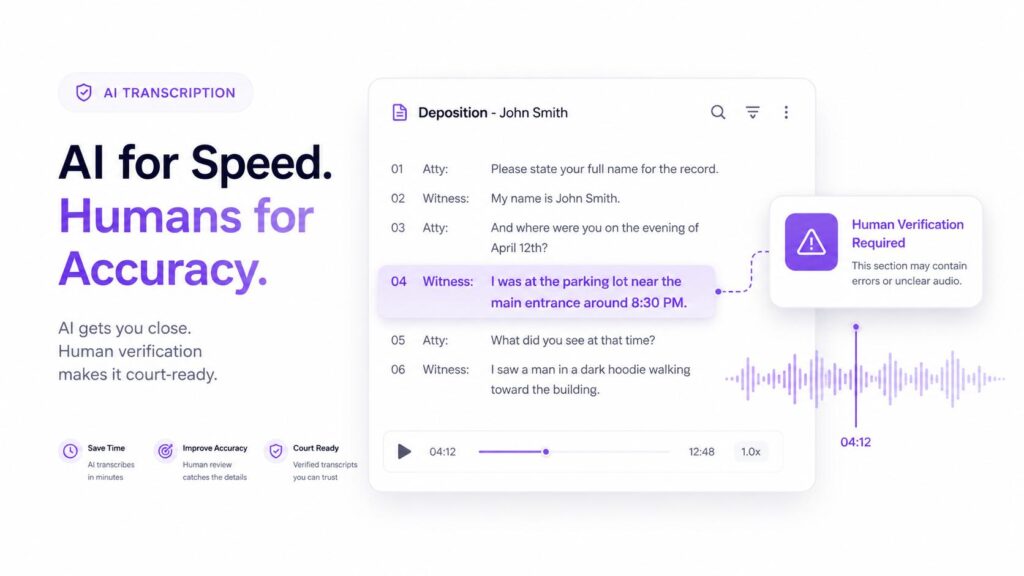
This is the part vendors talk about least, and it matters most in criminal defense specifically because BWC audio captures an unusually wide range of speakers, officers, witnesses, bystanders, and defendants from different linguistic backgrounds, often in noisy or low-quality audio conditions.
A 2020 study published in the Proceedings of the National Academy of Sciences found that leading commercial automatic speech recognition (ASR) systems produced word error rates for Black speakers of American English that were roughly double those for white speakers (Koenecke et al., 2020, DOI: 10.1073/pnas.1915768117). A more recent University of Washington linguistics study examining a multi-ethnic speaker corpus found comparable disparities across several commercial ASR systems.
| Speaker Group | Average Word Error Rate | Study |
| White American English speakers | ~19% | Pacific Northwest English (PNWE) corpus study, University of Washington |
| African American English speakers | ~35% | Same study, across five major commercial ASR systems |
| Black American speakers (general) | Roughly 2x the error rate of white speakers | Koenecke et al., 2020, PNAS |
The practical consequence for a defense attorney: an AI transcript is not equally reliable across every voice on the recording. If a witness statement or a defendant's own words are transcribed with a higher error rate because of dialect or accent, and that transcript is used to build a motion, cross-examination outline, or plea evaluation without independent verification, the risk isn't hypothetical, it's a documented, measurable gap in the underlying technology. Any AI-assisted review workflow needs a mandatory human spot-check step on contested or dispositive statements, not just a spell-check pass.
Pain Point #2: Data Security and Confidentiality Obligations
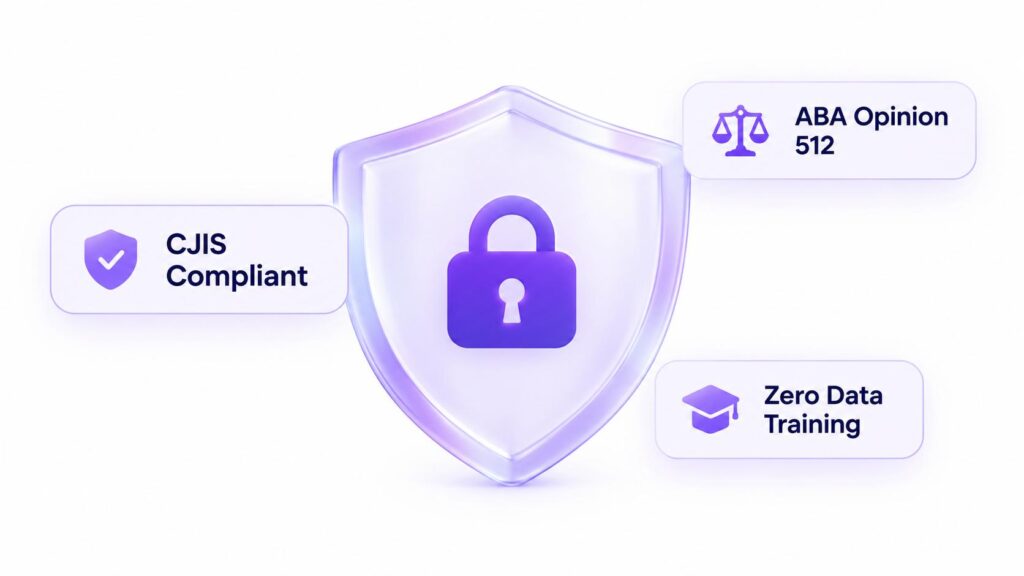
Body camera footage frequently includes protected health information, juvenile identities, domestic violence disclosures, and other legally sensitive content, on top of ordinary attorney work-product concerns. Vendors serving public defender and prosecutor offices are generally expected to host data in CJIS-compliant environments, and defense offices should confirm this in writing before uploading any footage, a written confidentiality addendum and clear rules about what identifying information should never enter a prompt are baseline requirements, not extras (Berkeley Law Criminal Law & Justice Center, AI for Public Defenders).
On top of vendor security, there's a professional responsibility layer. The American Bar Association's Formal Opinion 512, issued July 29, 2024, addresses generative and analytical AI tools directly, and takes the position that lawyers must reasonably understand a tool's capabilities and limitations, either by reading its terms of use and privacy policy themselves or consulting someone who has, before relying on its output in a case. The opinion also states that lawyers "must consider" whether client consent is required before using generative AI on a matter, which extends naturally to AI-assisted evidence review tools even when the tool isn't generating new text, only processing sensitive footage.
For attorneys who still rely on outside vendors for polished, court-ready documentation, deposition summaries, hearing records, or a certified legal transcript, the same due-diligence standard applies: know exactly where the recording is processed, who can access it, and how long it's retained.
Pain Point #3: Will a Court Actually Rely on It?
Having a fast transcript doesn't automatically mean it gets accepted or trusted where it matters. A 2023 study in the Journal of Empirical Legal Studies surveyed state prosecutors in Miami-Dade County on their real-world experience with BWC footage in court, and found that its usefulness varied significantly by case type and was shaped heavily by how well the footage was organized, indexed, and presented rather than by its mere existence in the case file (Petersen, Papy, Mouro & Ariel, 2023, DOI: 10.1111/jels.12358). In other words, unreviewed or poorly indexed footage, AI-processed or not, doesn't automatically translate into courtroom advantage.
This is also where authentication matters. AI-generated transcripts and clip compilations used as exhibits should be treated the same way any other derivative evidence is treated: with a clear chain of custody from the original recording, a documented review process, and a human who can testify to how the excerpt was produced if challenged. When a case is actually headed to trial, that same discipline extends to how the trial transcript itself is prepared, accuracy and defensibility matter more, not less, once testimony is on the record.
A 5-Step Workflow for Integrating AI Into BWC Review
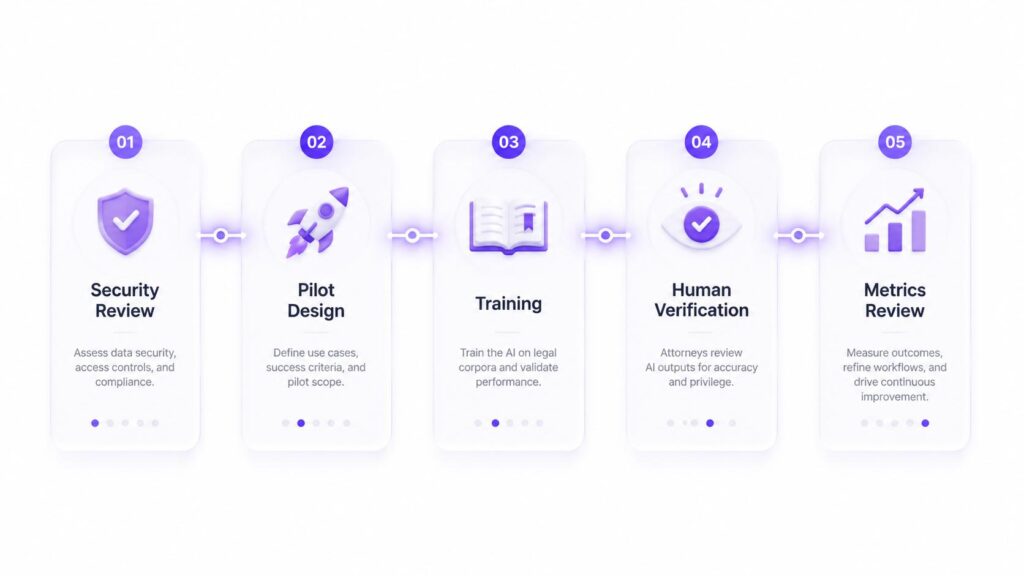
Based on the rollout framework used by Berkeley Law's Criminal Law & Justice Center for public defender offices piloting AI tools, a defensible workflow looks like this:
| Step | Key Actions | Common Pitfall to Avoid |
| 1. Security Review | Confirm CJIS-compliant hosting; sign confidentiality addendum; define what never enters a prompt | Skipping IT/ethics counsel review to save time |
| 2. Pilot Design | Start with one high-volume use case (e.g., BWC transcription); limit to a small case set and fixed timeframe | Rolling out firm-wide before validating accuracy |
| 3. Training | Run a short kickoff session covering features, limitations, and verification steps | Assuming attorneys will self-teach the tool |
| 4. Human Verification | Spot-check AI transcripts against original audio, especially contested statements | Treating AI transcripts as final without review |
| 5. Metrics Review | Track hours saved per case, transcript error rate, and motion outcomes at fixed intervals | Never revisiting whether the tool is actually working |
Choosing a Body Camera AI Tool: What to Actually Check
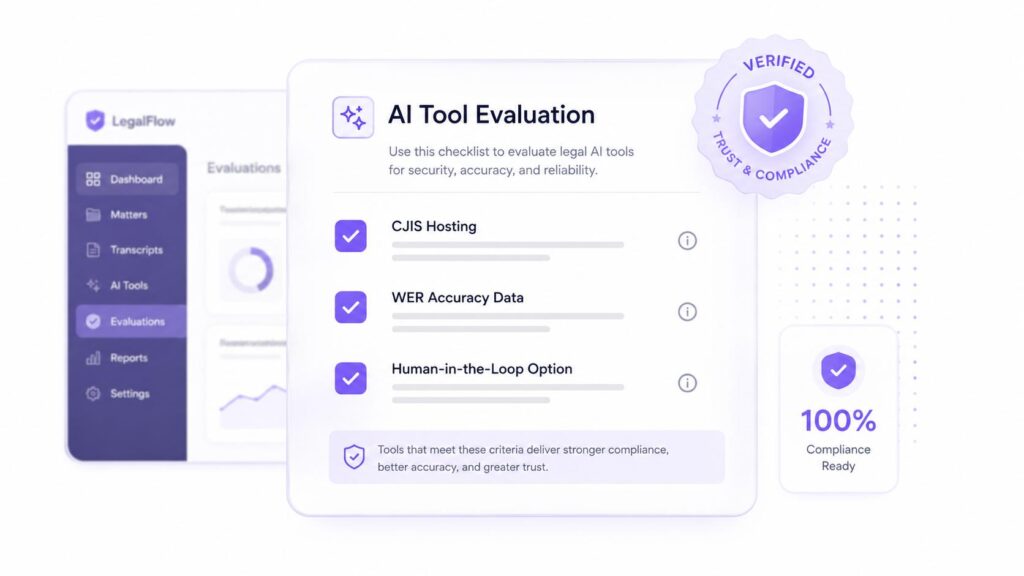
| Evaluation Criterion | Why It Matters | Questions to Ask the Vendor |
| CJIS-compliant hosting | Legal requirement for handling law enforcement data | Where is data physically hosted, and is it certified? |
| Published accuracy/WER data | Determines reliability across speaker groups | Do you disclose error rates across dialects/accents? |
| Human-in-the-loop option | Reduces risk from ASR bias and hallucination | Can attorneys flag and correct transcript errors easily? |
| Court-tested track record | Signals real-world reliability under scrutiny | Has output from this tool been challenged or admitted in court? |
| Confidentiality terms | Governs ethical compliance under ABA guidance | Who can access uploaded footage, and for how long? |
Frequently Asked Questions
Can AI-generated body camera transcripts be used directly as court evidence?
Not on their own. AI transcripts are typically treated as a review aid rather than a certified record. If a transcript or clip is offered as an exhibit, it generally needs to be authenticated and tied to a documented chain of custody, with someone able to testify to how it was produced.
Is AI transcription of body camera footage accurate for every speaker?
No. Published research shows measurable accuracy gaps across dialects and accents in commercial speech recognition systems, so attorneys should treat AI transcripts as a starting point requiring human verification, not a finished product.
Do defense attorneys need client consent to use AI on case evidence?
The ABA's Formal Opinion 512 states that lawyers must consider whether informed consent is required before using generative AI on a client matter, a standard that reasonably extends to AI tools processing sensitive case footage.
How is AI different from traditional human transcription for legal use?
AI tools prioritize speed and searchability across large volumes of footage; human-verified transcription prioritizes certified accuracy for use in formal proceedings. Many defense teams use AI for first-pass review and reserve human transcription for anything headed into a filing or hearing record.
AI-assisted body camera review has clearly earned its place in criminal defense workflows, the caseload math leaves little alternative. But the technology's accuracy gaps, security obligations, and courtroom scrutiny are not edge cases; they're built into how these tools currently work. Treating AI output as a first draft, not a final answer, is what actually protects both the client and the case.