


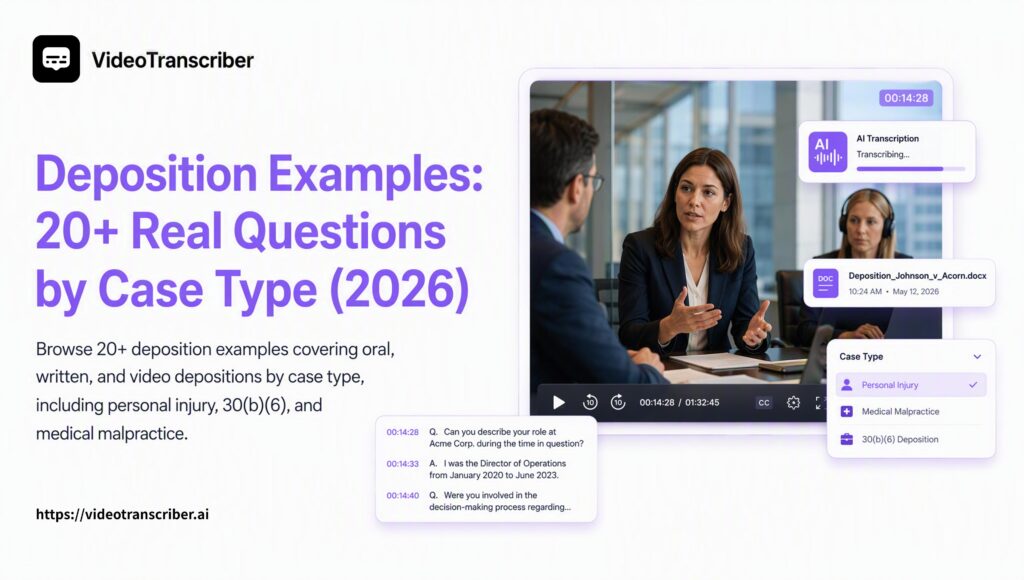
Depositions can make or break a case long before trial. From Bill Cosby's unsealed 2005 testimony to Alex Jones' document disclosures, sworn out-of-court statements routinely alter case outcomes.
Done right, depositions lock witnesses into facts and shape trial strategy; done wrong, they waste time or hand opposing counsel critical evidence. This guide covers federal rules, airtight notice drafting, four core question types by case type, and essential litigation takeaways.
What Is a Deposition? The Core Framework in 60 Seconds
Depositions are sworn, out-of-court testimonies recorded by a court reporter during the pre-trial discovery phase, typically near the end, after document production has established the paper trail. Conducted under oath to gather information, preserve testimony, and shape trial strategy, every recorded word can be used against a witness at trial, making them a high-stakes tool that can make or break a case long before anyone steps into a courtroom.
Who Must Be in the Room, Required Participants
Every valid deposition requires at minimum:
| Role | Function |
| Deponent (Witness) | The person being questioned under oath |
| Deposing Attorney | Conducts direct examination |
| Defending Attorney | Represents the deponent; raises objections |
| Certified Court Reporter | Records the session verbatim; administers the oath |
| Videographer (if video deposition) | Records the session on camera |
| Interpreter (if needed) | Required when deponent is not fluent in English |
Third-party witnesses may also bring their own counsel, though they are not required to.
Three Formats You Need to Know: Oral, Written (DWQ), and Video
| Format | Best Used For | Key Limitation |
| Oral | Complex fact witnesses; expert witnesses; high-stakes testimony | Requires physical coordination; more expensive |
| Written (DWQ, Deposition on Written Questions) | Document custodians; remote witnesses; straightforward records requests | No live follow-up; misses tone and demeanor |
| Video | Witnesses unlikely to appear at trial; expert testimony; preserving demeanor for jury | Equipment and logistics; admissibility rules apply |
Deposition Notice Examples, Key Elements, Templates & Common Mistakes
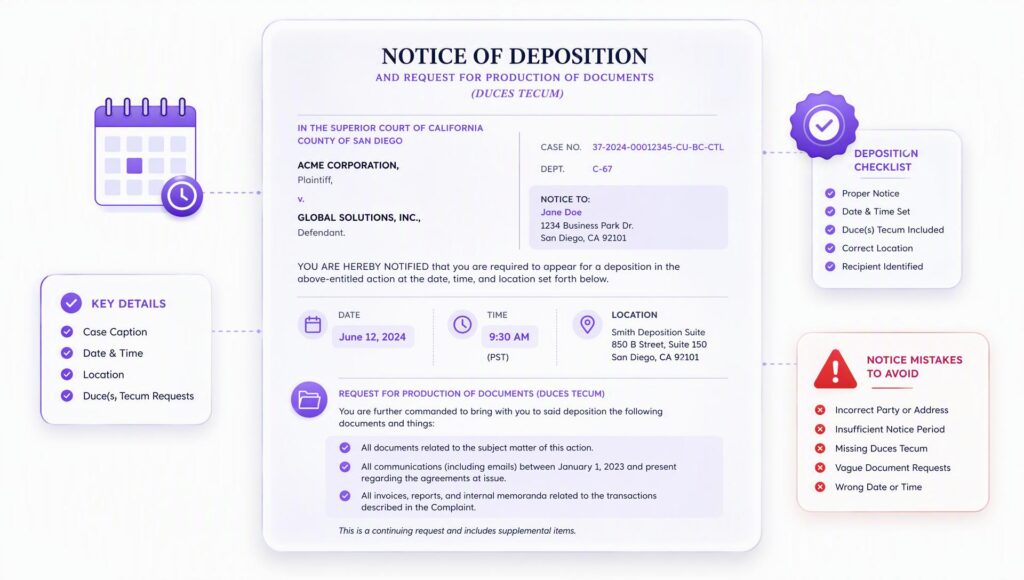
A defective notice can get a deposition thrown out, give the opposing party grounds to seek a protective order, or leave the deposing attorney scrambling to re-notice at their own expense. Getting the notice right is non-negotiable.
What Every Valid Deposition Notice Must Include
Seven elements belong in every deposition notice:
- Case caption and court information, jurisdiction, case number, and parties
- Identity of the deponent, full name, title, and address if known
- Date, time, and location, specific enough that there is no ambiguity
- Method of recording, stenographic, audio, video, or combination; if video, state it explicitly
- Documents requested (duces tecum), a specific list of records the witness must bring; vague requests invite objections
- Designation of the court reporter, name of the reporting agency or specific reporter, if known
- Attorney signature block, name, bar number, firm, contact information, and whom the attorney represents
Sample Notice #1, Standard Oral Deposition (Fact Witness)
IN THE UNITED STATES DISTRICT COURT
FOR THE [DISTRICT NAME]

[PLAINTIFF NAME],          )
    Plaintiff,             )   Civil Action No. [CASE NUMBER]
                           )
v.                         )
                           )
[DEFENDANT NAME],          )
    Defendant.             )

NOTICE OF DEPOSITION OF [WITNESS FULL NAME]

TO: All Parties and Their Attorneys of Record

PLEASE TAKE NOTICE that pursuant to Federal Rule of Civil Procedure 30,
Plaintiff [Name] will take the oral deposition of [Witness Full Name],
[Title/Occupation], at the following time and location:

DATE:      [Day, Month Date, Year]
TIME:      [Start Time, e.g., 10:00 a.m.]
LOCATION:  [Full Address, Suite Number, City, State, ZIP]

The deposition will be recorded by stenographic means by a certified
court reporter and may also be recorded by video.

Pursuant to Federal Rule of Civil Procedure 30(b)(2), the deponent
is requested to bring to the deposition the following documents:

    1. All emails, memoranda, and correspondence related to [Topic A]
       from [Date Range];
    2. All contracts or agreements between [Party A] and [Party B]
       dated [Date Range];
    3. Any notes, logs, or records prepared by or for the deponent
       relating to [Specific Event or Topic].

                          Respectfully submitted,

                          [Attorney Full Name], Esq.
                          Bar No. [Number]
                          [Law Firm Name]
                          [Address]
                          Tel: [Phone]
                          Email: [Email]
                          Attorney for [Plaintiff/Defendant]

Date: [Date]
Sample Notice #2, 30(b)(6) Corporate Designee Notice
A Rule 30(b)(6) notice is categorically different from a standard deposition notice. You are not deposing a named individual, you are deposing the organization itself, which must then designate one or more representatives to testify on the specified topics. The organization's designee speaks for the company as a whole.
What Topics Must Be Specified in a 30(b)(6) Notice?
The topics must be described with "reasonable particularity", vague or overbroad topic descriptions give the organization grounds to object or to send an unprepared designee, which courts have sometimes allowed when the notice failed to give adequate guidance.
Best practice: draft topic descriptions as specific as you would a deposition question. Not "company policies," but "all written policies regarding employee overtime compensation in effect between January 1, 2020 and December 31, 2023, and the process by which those policies were reviewed or updated."
IN THE UNITED STATES DISTRICT COURT
FOR THE [DISTRICT NAME]

[PLAINTIFF NAME],          )
    Plaintiff,             )   Civil Action No. [CASE NUMBER]
v.                         )
[DEFENDANT CORPORATION],   )
    Defendant.             )

NOTICE OF 30(b)(6) DEPOSITION OF DEFENDANT [CORPORATION NAME]

TO: Defendant [Corporation Name] and Its Attorneys of Record

PLEASE TAKE NOTICE that pursuant to Federal Rule of Civil Procedure
30(b)(6), Plaintiff will take the deposition of Defendant [Corporation
Name] by and through one or more duly designated officers, directors,
managing agents, or other persons who consent to testify on its behalf
concerning the following matters:

TOPICS FOR EXAMINATION:

    Topic 1: The corporate structure of [Corporation], including all
    subsidiaries and parent entities, as of [Date Range].

    Topic 2: All written policies and procedures governing [Specific
    Business Practice], in effect from [Date] to [Date].

    Topic 3: Any internal investigations, audits, or reviews conducted
    by or on behalf of [Corporation] regarding [Subject Matter] from
    [Date] to present, including the findings, recommendations, and
    follow-up actions taken.

    Topic 4: All communications between [Corporation] and [Third Party]
    concerning [Specific Transaction or Event] from [Date] to [Date].

    Topic 5: The identity of all persons with knowledge of the matters
    described in Topics 1 through 4, and the nature of their knowledge.

Defendant is requested to identify, at least 7 days before the
deposition, the name and title of each designee and the topics each
designee will address.

DATE:      [Day, Month Date, Year]
TIME:      [Start Time]
LOCATION:  [Full Address]

                          [Attorney Signature Block]
Real Case: What Happens When a 30(b)(6) Designee Is Unprepared
Courts have held that producing an unprepared 30(b)(6) designee is the legal equivalent of producing no designee at all, it is treated as a failure to appear, which can result in sanctions. In Brazos River Authority v. GE Ionics, Inc., 469 F.3d 416 (5th Cir. 2006), the court held that a corporation's failure to adequately prepare its 30(b)(6) witness on designated topics could warrant sanctions, including adverse inference instructions at trial.
The practical takeaway: the organization bears the burden of preparation. If your client receives a 30(b)(6) notice, the designee must be ready to testify not just from personal knowledge but from the organization's collective knowledge on every listed topic.
Sample Notice #3, Videotaped Expert Witness Deposition
NOTICE OF VIDEOTAPED DEPOSITION OF EXPERT WITNESS [FULL NAME], [CREDENTIALS]

PLEASE TAKE NOTICE that Plaintiff will take the oral, videotaped
deposition of [Expert Name], [PhD/MD/PE], retained as an expert witness
by Defendant, at the following time and location:

DATE:      [Date]
TIME:      [Time]
LOCATION:  [Address]

This deposition will be recorded by both stenographic means and
video recording. The video recording will be conducted by a licensed
videographer from [Videography Company]. The video format will be
[MP4/H.264] and will be retained by the deposing party.

The witness is requested to bring to the deposition:

    1. A complete and current curriculum vitae;
    2. All reports, written opinions, and draft reports prepared in
       connection with this matter;
    3. All materials reviewed or relied upon in forming any opinions
       offered in this matter, including but not limited to studies,
       articles, data sets, and testing results;
    4. All prior trial or deposition testimony given in the last
       four years, by case name, court, and date;
    5. All communications with Defendant's counsel regarding this matter.

                          [Attorney Signature Block]
5 Common Mistakes in Deposition Notices (and How to Fix Them)
| Mistake | Consequence | Fix |
| No recording method specified | Opposing party objects to surprise video recording. | Always specify \"stenographic and/or video\" in the notice. |
| Broad duces tecum requests | Organization produces nothing or overwhelms with documents. | Draft specific, date-bounded, and subject-limited requests. |
| Noticing a non-party without a subpoena | Non-party has no legal obligation to appear. | Always pair a Rule 45 subpoena with the notice. |
| No lead time for 30(b)(6) designees | Organization sends an unprepared witness, triggering motions. | Require designee identification 7 days prior within the notice. |
| Double-booked conference room | Deposition collapses before it starts. | Confirm room bookings in writing with full suite/room details. |
The 4 Types of Deposition Questions, With Real Examples by Case Type
This is the engine of every effective deposition. The four categories below, adapted from the litigation framework used by paralegals and trial attorneys, form a complete system. Each type serves a different strategic purpose, and the best depositions move through all four in sequence.
Type 1, Background & Foundational Questions
Purpose: Confirm the deponent's identity, establish their relationship to the facts, and create the credibility baseline against which all later testimony is measured. These questions feel routine. They are not. Inconsistencies here, a job title that doesn't match employment records, a date of hire that conflicts with an HR file, are exactly the kind of small contradictions that undermine a witness at trial.
Best practice: Do not rush through foundational questions. Attorneys who treat them as a formality miss the opportunity to nail down details that become important later.
Personal Injury Cases:
- State your full name, current address, occupation, and tenure in your position.
- Confirm your presence, reason for being, and physical/mental state (sleep, medication) at the scene on the incident date.
- Disclose any prior involvement in personal injury lawsuits.
- Identify anyone spoken with and documents reviewed in preparation for the deposition.
- Confirm understanding of the oath.
Corporate Employment Disputes:
- State your full name, job title, employment dates, and direct supervisors.
- Detail your supervisory scope and employee headcount.
- Describe your involvement in the plaintiff's performance reviews.
- Disclose any prior internal HR investigations at current or former employers.
- Identify HR policies or employee handbooks reviewed for the deposition.
Type 2, Narrative-Building Questions
Purpose: Let the witness tell their story in their own words, in chronological sequence. Open-ended narrative questions ("describe what happened," "walk me through your decision") surface details that yes/no questions never reach. They also expose the natural gaps, hesitations, and contradictions in a witness's account, material that skilled attorneys exploit later.
The goal is not to interrupt. It is to listen, note inconsistencies, and return to them with specific follow-up. The best impeachment material often comes from allowing a witness to over-explain.
In a Medical Malpractice Case
- Describe, step by step, the pre-operative process you followed with this patient.
- Who else was present during the pre-operative briefing?
- Can you walk me through the informed consent process, specifically, what risks did you discuss with the patient, and how did you document that conversation?
- At what point did you first recognize that something had gone wrong during the procedure? Describe exactly what you observed.
- What did you do in the thirty minutes immediately following that observation?
- Who was notified, and in what order, about the complication?In a Contract Dispute
- Walk me through the negotiation history of this contract from the first conversation to the signing date.
- Were there any terms discussed verbally that did not make it into the final written contract? Describe them.
- At any point did either party express reservations about the deliverable schedule? How was that handled?
- What was your understanding of the indemnification clause at the time you signed?
- After signing, did your interpretation of any term change? What prompted that change?Type 3, Exhibit & Expert-Oriented QuestionsPurpose: Tie witnesses directly to documentary evidence. Authenticate documents for trial. Challenge expert methodology. This is where the paper trail meets sworn testimony, and where attorneys either lock in crucial admissions or expose weaknesses in their own evidence.For exhibits, the sequence matters: identify → authenticate → confront. Show the document, confirm the witness recognizes it, establish their connection to it, then use it to ask what you really want to know.Authenticating Documents, Questions That Lock a Witness to the Record
- Identify and authenticate marked exhibits (e.g., Exhibit 7).
- Verify signatures and authorship of specific emails or correspondence.
- Establish distribution lists and who received copies upon circulation.
- Confirm whether the witness read the full document or only portions before signing.
- Track document retention and the current location of copies.
Challenging an Expert Witness, The 5-Question Framework
Every expert deposition should work through five categories:
- Qualifications: "Have you ever testified as an expert in a case involving [this specific sub-field]? How many times? On which side?"
- Methodology: "Describe the step-by-step method you used to reach your opinion. Is this method peer-reviewed and generally accepted in your field?"
- Data sources: "What data did you rely on? Did you independently verify that data? Did you exclude any data, if so, why?"
- Alternative explanations: "Before concluding [Opinion X], did you consider [Alternative Explanation Y]? Why did you rule it out?"
- Financial relationship: "How much has your firm been paid by the defendant in this matter? How much of your annual income comes from serving as an expert witness?"
Type 4, Impeachment Questions
Purpose: Challenge credibility. Surface inconsistencies between the deponent's current testimony and prior statements, documents, or other witnesses. Impeachment questions are not about winning the deposition, they are about building the record that wins the trial.
The technique is sequential: first, commit the witness to their current position. Then introduce the contradictory evidence. Never reverse the order.
Confronting a Prior Inconsistent Statement, Step by Step
Step 1: Lock in the current testimony.
"You've testified today that you first became aware of the safety issue on [Date B]. Is that correct?"
Step 2: Confirm they have no qualification or addition to that answer.
"Is there anything about that date you're uncertain of, or is [Date B] your best recollection?"
Step 3: Introduce the prior statement without comment.
"I am showing you Exhibit 14, which is a memorandum you authored on [Earlier Date A]. Please read the highlighted passage."
Step 4: Confront directly.
"In that memo, you wrote that you had been informed of the safety issue as of [Earlier Date A], approximately six months before the date you gave in your testimony today. How do you reconcile those two statements?"
Financial Bias Impeachment, Questions That Reveal Conflicts of Interest
- How much have you been paid, in total, by the defendant or defendant's counsel in connection with this matter?
- In the past five years, what percentage of your expert witness work has been retained by defendants (as opposed to plaintiffs)?
- Have you ever testified on behalf of a plaintiff in a case involving [this subject matter]? In how many cases?
- Do you have any prior professional relationship with any attorney or firm representing defendant in this matter?
Deposition Transcript Format, Structure, Anatomy & What Courts Require
A deposition transcript is a legal document. Courts, attorneys, and potentially juries will rely on it. Every formatting choice either adds clarity or creates ambiguity, and ambiguity in a legal document always benefits the party who did not produce it.
The 6 Structural Elements of a Legally Sound Transcript
1. Cover Page The cover page identifies the case (court, docket number, parties), the deponent, the date, time, and location, and the court reporting firm. It is the document's face, and it must be accurate.
2. Appearances Page Lists every person present: each attorney (name, firm, client they represent), the deponent, the court reporter, the videographer if applicable, and any interpreter. If someone left the room during the deposition, that departure should be noted in the transcript body.
3. Oath/Affirmation Record The transcript must reflect the administration of the oath or affirmation by the officer, typically the court reporter or notary. Without a recorded oath, the transcript may not be admissible.
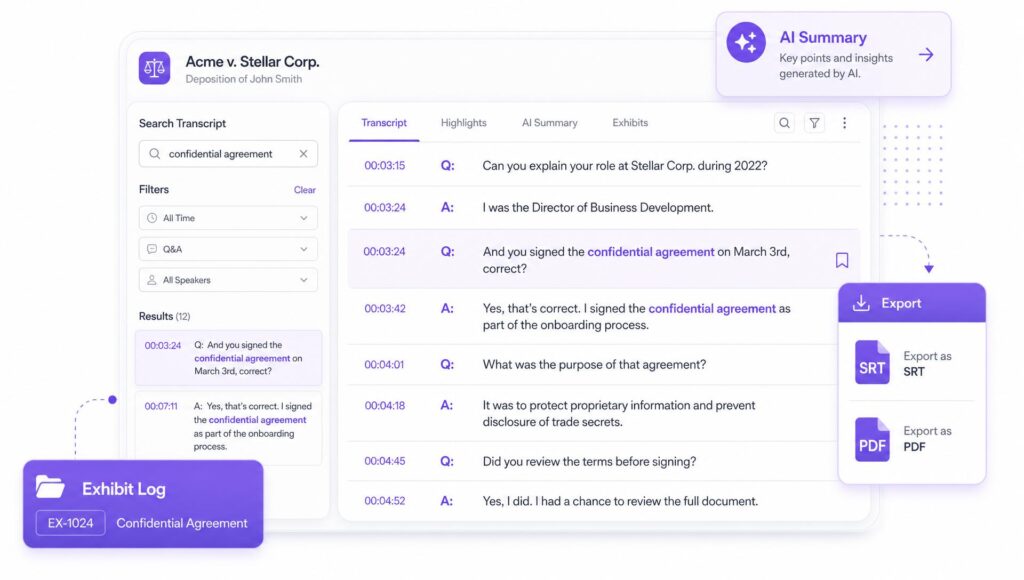
4. Q&A Body The main body of the transcript uses a strict Q&A format:
- Structure: Strict Q&A format using "Q" for attorney questions and "A" for deponent answers, with speaker identification preceding each statement.
- Layout: Numbered lines on the left margin (standard 25 lines per page) and page numbers in the upper right or upper center.
- Objections: Transcribed verbatim, placed immediately following the question.
5. Exhibit Log All documents introduced during the deposition are numbered sequentially as exhibits. The transcript body references them by exhibit number when introduced ("I'm showing you what has been marked as Exhibit 12..."). The exhibit log at the end of the transcript identifies each by number and description.
6. Witness Signature Page (Errata Sheet) After the transcript is prepared, the deponent typically has 30 days (varies by jurisdiction) to review it and note any errors via an errata sheet. The signature page records whether they reviewed and signed, reviewed and made corrections, or waived review.
How to Format Speaker Identification, Objections, and Non-Verbal Notes
Objections: Transcribed immediately after the question, before the answer, in the format:
[ATTORNEY B]: Objection. Form.
[ATTORNEY A]: You may answer.
A: [Answer]
If an instruction not to answer is given, that instruction and the deponent's compliance (or non-compliance) must be on the record:
[ATTORNEY B]: Objection. Privilege. I instruct the witness not to answer.
[ATTORNEY A]: Noting the instruction on the record. We'll move on
               and reserve the right to seek a court ruling.
Non-verbal notes: Significant non-verbal events that affect the record should be noted:
[WITNESS REVIEWS DOCUMENT][WITNESS PAUSES APPROXIMATELY 30 SECONDS][SIMULTANEOUS SPEECH][OFF THE RECORD DISCUSSION, 11:42 a.m. to 11:49 a.m.]
Deposition Transcript vs. Deposition Summary, When You Need Which
| Format | What It Is | When to Use It |
| Full Transcript | Verbatim record of every question and answer | Trial preparation; impeachment; when exact wording is disputed |
| Deposition Summary | Condensed version highlighting key testimony by topic | Case review; settlement negotiation; briefing attorneys not present at the deposition |
| Chronological Summary | Key testimony organized by timeline of events | Cases where the sequence of events is disputed |
| Topic Summary | Key testimony organized by legal issue | Complex multi-issue cases; appellate record preparation |
For cases involving hours of recorded deposition testimony across multiple witnesses, professional transcription and summarization services dramatically reduce preparation time. AI-assisted transcription tools can generate a searchable, time-stamped transcript from a video deposition, making the review process substantially faster and more accurate than working from audio alone. See our overview of AI-powered deposition transcript tools for a detailed breakdown of what these services offer and how they integrate into standard legal workflows.
How to Structure Your Full Line of Questioning, The 4-Stage Blueprint
- Stage 1 (Background): Anchor identity, credentials, and preparation to establish a baseline and expose early inconsistencies.
- Stage 2 (Narrative): Elicit the witness's unfiltered story before showing documents to capture spontaneous recollections and omissions.
- Stage 3 (Exhibits): Introduce paper trails and documents to directly confront and contrast with prior narrative testimony.
- Stage 4 (Impeachment): Lock in testimony and introduce inconsistent statements to build a robust trial record.
The Paralegal's Pre-Deposition Checklist (20-Point)
Document preparation
- [ ] All relevant documents organized chronologically and by topic
- [ ] Each document pre-marked as a deposition exhibit
- [ ] Copies made for deponent, all attorneys, and the court reporter
- [ ] Document production log reviewed for any gaps or missing records
Question preparation
- [ ] Four-stage question outline drafted
- [ ] Each question reviewed against the documentary record
- [ ] Anticipated objections identified and response strategy noted
- [ ] Follow-up questions drafted for expected evasive answers
Logistics
- [ ] Conference room confirmed and reserved
- [ ] Court reporter booked and confirmed
- [ ] Videographer booked (if video deposition)
- [ ] Interpreter arranged (if needed)
- [ ] Remote access tested (if remote deposition)
Witness preparation (for your client)
- [ ] Witness briefed on the oath and its significance
- [ ] Witness instructed on the answer-only-what-is-asked principle
- [ ] Witness coached on requesting clarification vs. guessing
- [ ] Mock deposition conducted with at least one rehearsal
- [ ] Attorney and witness aligned on topics that may be privileged
Post-deposition
- [ ] Transcript ordered from court reporter
- [ ] Errata sheet deadline calendared (typically 30 days)
- [ ] Key admissions flagged in transcript for trial preparation file
Critical Mistakes That Undermine a Deposition
- Over-Answering: Volunteering unprompted information is the #1 witness error. Witnesses should answer only what is asked—yes/no when applicable, or a brief factual statement without explanation, justification, or elaboration.
- Failing to Object on the Record: Under FRCP Rule 32(d)(3), objections to the form of a question (e.g., leading, compound, or assuming facts) must be made during the deposition, or they are permanently waived at trial. (Admissibility objections like hearsay or relevance can wait.)
- Vague or Overbroad 30(b)(6) Notices: Poorly scoped corporate notices trap litigants—either allowing companies to send unprepared witnesses due to overly broad topics, or leaving essential areas uncovered due to overly narrow descriptions. Topics must be drafted with surgical precision.
- Transcript Errors: Court reporters frequently mishear technical, medical, or specialized jargon (e.g., transcribing "ileum" as "elbow"). Witnesses should always spell out complex terms on the record, and technical transcripts must be reviewed by domain experts.
Frequently Asked Questions About Deposition Examples
What are the most commonly asked questions in a deposition?
Every deposition begins with a set of foundational questions: the deponent's full name, current address, prior deposition experience, medications that might affect testimony, and confirmation that they understand they are under oath. From there, questions shift based on the case type, background questions in employment disputes will look very different from background questions in a product liability case. The one constant: some version of "walk me through what happened" appears in virtually every deposition, in every practice area.
Can a deposition transcript be used as evidence at trial?
Under FRCP Rule 32, yes, but only under specific conditions. The most common uses are: (1) to impeach a witness whose trial testimony contradicts their deposition, (2) to introduce testimony from a witness who is unavailable at trial due to death, illness, or distance, and (3) any portion of an opposing party's deposition, which can be used against them for any purpose. Transcripts that contain inadmissible content (privileged communications, hearsay not meeting an exception) may be partially admitted with the inadmissible portions redacted.
How long does a typical deposition last?
Under FRCP Rule 30(d)(1), federal depositions are limited to seven hours of examination time per witness per day. In practice, most fact witness depositions run two to four hours. Expert witness depositions, corporate 30(b)(6) depositions, and depositions of key parties in complex cases routinely run the full seven hours. Depositions in highly complex commercial litigation sometimes require court approval for additional days.
What should a witness never say during a deposition?
Four answers consistently create problems:
- "I don't recall" when you actually do recall, Perjury risk, and cross-examination at trial can expose it
- "I think" or "I believe" when you know the answer, Signals uncertainty that opposing counsel will exploit
- Anything beyond what the question asked, Over-answering is the most common witness error
- Guesses stated as facts, If you do not know, say you do not know
How does a video deposition differ from a standard oral deposition?
- The Strategic Power of Video: While the rules, oaths, and limits are identical to standard oral depositions, video captures critical demeanor—tone, hesitation, body language, and discomfort—that can be played directly for a jury. This makes them ideal for compelling witnesses who cannot attend trial, but also raises the stakes: appearing evasive, arrogant, or rehearsed on camera severely damages how a jury perceives the testimony.
- Notice Requirement: The deposition notice must explicitly state that the session will be recorded on video. Springing a videographer on opposing counsel without prior written notice gives them grounds to object.