


A single witness statement can shift the outcome of an entire legal case. It can confirm who caused an accident, establish the severity of injuries, and fill gaps that police reports leave behind. But a poorly written one, vague, disorganized, missing critical facts, does more harm than good.
The problem isn't complexity. Most people understand that witness statements need to be accurate and detailed. The real issue is that standard writing advice focuses on format when it should focus on persuasion. You can follow every rule about numbered paragraphs and chronological order, and still write a statement that a judge dismisses or an insurance adjuster tears apart.
This guide teaches you what matters: how to build a statement so airtight that defense attorneys and skeptical investigators can't dismantle your credibility before they even evaluate the facts.
The Legal Foundation: What Makes a Witness Statement Binding
Before you write a single word, understand the legal weight behind it. In U.S. federal proceedings, 28 U.S.C. § 1746 authorizes unsworn declarations made "under penalty of perjury", meaning a properly signed witness statement carries the same legal force as a sworn affidavit, without requiring a notary. In California state courts, the equivalent is California Code of Civil Procedure § 2015.5, which specifies the exact declaration language required for unsworn statements to be admissible.
Critical note: Perjury statutes and declaration requirements vary by jurisdiction. What satisfies § 2015.5 in California may not meet requirements in Texas, New York, or federal court. Always confirm the precise closing language required in your specific jurisdiction, or ask the attorney handling your case, before you sign and submit.
The 5 Credibility Traps That Kill Most Witness Statements
Trap #1: Vague Time and Location References
"Sometime in the afternoon" and "near the parking lot" sound reasonable when you're writing, but to a lawyer reading your statement, they're red flags. They signal that either you don't remember clearly, or you're being deliberately imprecise.
Fix: Anchor every reference to a specific time and place. "Approximately 2:47 PM" beats "around 3 PM." "At the northeast entrance of the parking structure on the corner of Sunset and Vine" beats "near the parking lot." Specificity increases credibility.
Trap #2: Mixing Observation With Opinion
"He was drunk" is an opinion. "He walked with an unsteady gait and his words were slurred" is an observation. The difference matters enormously in court.
When you blend observation and conclusion, defense attorneys will isolate every subjective phrase and attack it. They'll question your judgment, your bias, your ability to read situations. But they can't argue with sensory data: what you saw, heard, and felt.
The fix: Every statement should describe observable facts. Replace "She was in pain" with "She was holding her right arm against her chest and winced when she moved it." The observation does the work the opinion was trying to do, but without vulnerability.
Trap #3: The "Too Perfect" Memory
Paradoxically, remembering every detail can make you look unreliable. Judges and adjusters know human memory is fallible. When a witness account is flawless, they wonder: is this real, or reconstructed?
The fix: Admit uncertainty strategically. "I clearly remember the collision, but the exact time is fuzzy, somewhere between 2:30 and 2:45 PM" sounds far more credible than "I remember everything perfectly."
Trap #4: Disconnected Evidence
Listing exhibits at the end ("Exhibit A: Photo, Exhibit B: Medical records") makes them feel like decorations. Defense attorneys will use them against you because they're not woven into your narrative.
The fix: Reference evidence within your statement. "The damage to the rear bumper is visible in the photograph I took at 2:50 PM (Exhibit A), showing the exact impact point I described."
Trap #5: Weak Opening and Closing
Your first paragraph determines whether a judge keeps reading or starts skimming. Your final declaration determines whether your statement has legal weight.
The fix: Open with your identity and positioning. "I am [Name], of [Address], and at 2:15 PM on [Date], I was standing at the northeast corner of Main and Fifth Street." Close with a jurisdiction-appropriate declaration. In federal proceedings or where § 1746 applies, the standard language is:
"I declare (or certify, verify, or state) under penalty of perjury that the foregoing is true and correct. Executed on [Date]."
In California state proceedings under CCP § 2015.5:
"I declare under penalty of perjury under the laws of the State of California that the foregoing is true and correct."
Confirm the required wording with your attorney or the court before submitting.
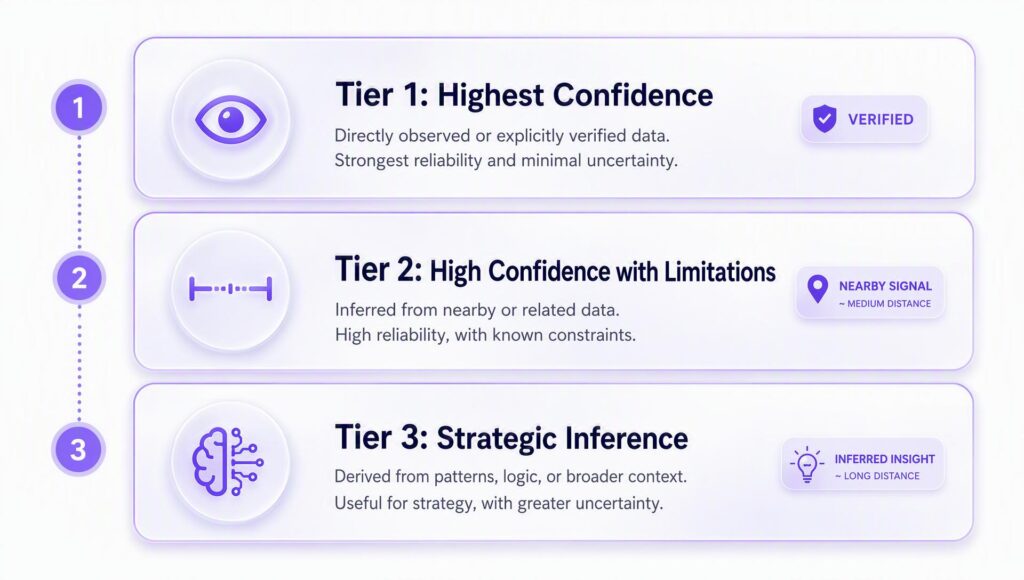
The Three-Tier Credibility Ladder
Strong witness statements aren't built on false objectivity. They're built on strategic transparency. Here's how:
Tier 1 , Highest Confidence: These are details you're absolutely certain about. Your location, what you could clearly see, times and dates. This foundation must be bulletproof.
Tier 2 , High Confidence With Honest Limitations: You observed most of this, but from a distance, or at an angle, or under imperfect conditions. You acknowledge the limitation without sounding unreliable. "From my position thirty meters away, I could see..." "The lighting was poor, but I could clearly make out..."
Tier 3 , Reconstruction and Inference: These are conclusions you've built from multiple observations. They're the weakest, but they're also the most persuasive, if you show your work.
Instead of: "He wasn't paying attention."
Write: "His eyes were fixed downward on an object in his right hand. The vehicle did not slow approaching the intersection. There was no steering correction before impact."
The observations support an inference so obvious the reader reaches it themselves. That's far stronger than you stating the conclusion.
Building Unbreakable Inference Chains
Defense attorneys will attack your judgment, but they can't argue with logic. This is your armor.
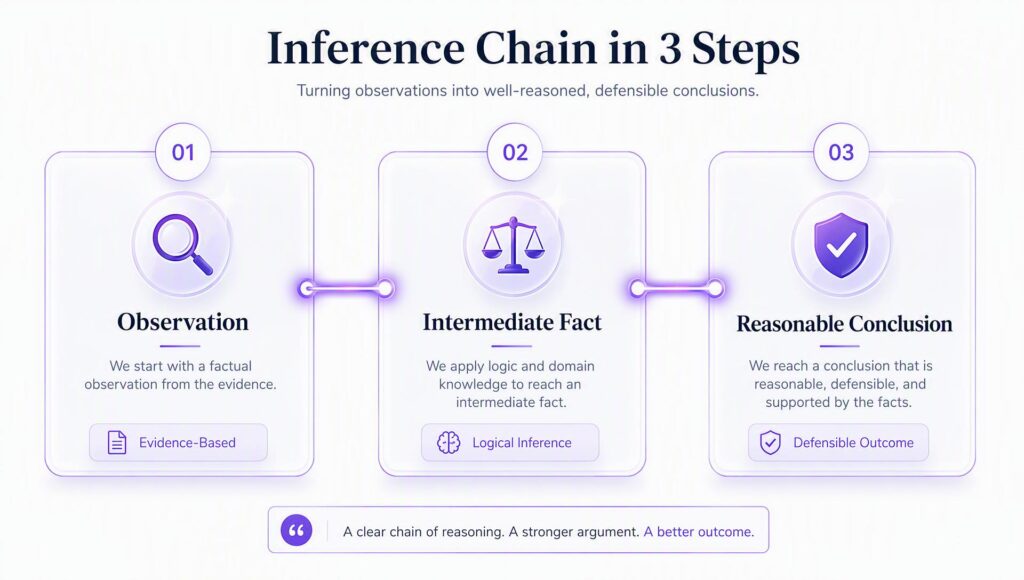
Every key inference in your statement should follow this pattern:
Observation → Intermediate Fact → Reasonable Conclusion
For example:
- (Observation) "The vehicle passed through the red light without slowing."
- (Intermediate Fact) "The driver's hands remained steady; there was no brake light illumination."
- (Reasonable Conclusion) "This indicates the driver did not attempt to stop."
You've built a chain. Even if they question your judgment about intent, the observable facts remain undeniable.
Reverse-Defense Architecture: Answer Objections Before They're Asked
The strongest statements anticipate the five questions opposing counsel will raise:
- "Why could you see clearly from where you were?" → Establish your position early. Describe sightlines, lighting, distance, obstacles.
- "How reliable is your memory?" → Provide specific details (showing you took time to observe), and acknowledge what you're less sure about.
- "Don't you have a bias?" → Disclose your relationship to the case upfront. "I am the cousin of [Party], but I am reporting only what I personally observed."
- "Why does your account differ from others?" → Explain reasonably. "I was positioned on the north side of the intersection, while other witnesses were south of it. From my angle, I had a clear view of the signal timing."
- "Where is corroboration?" → Mention other witnesses or evidence naturally throughout. "Officer Johnson was also at the scene and took photographs (Exhibit B)."
Weave these answers into your statement so they feel like part of the narrative, not a defensive response.
The Simple Structure That Works
Opening Block:
WITNESS STATEMENT

Full Name: [Your Name]
Address: [Your Address]
Phone: [Number]
Date of Birth: [Date]
Relationship to Case: [Eyewitness / Injured Party / Coworker]
Statement Date: [Date]
Scene-Setting Paragraph: Establish where you were, what you were doing, why you had a clear view.
Timeline (Before–During–After): Start before the incident. Describe your baseline position and attention level. Then slow down through the crucial moment. Then finish with what happened immediately after.
Evidence References: Naturally weave in your exhibits. "The photograph I took at 2:50 PM (Exhibit A) shows..."
Closing Declaration: Use the jurisdiction-specific perjury declaration language confirmed by your attorney or the court (see the Legal Foundation section above). Sign, date, and include your location.
Before/After: What Strong Statements Look Like
Weak: "The driver was going too fast. He ran the red light and hit my car. I was scared and in pain."
Strong: "I was standing at the northeast corner of Main and Fifth, waiting to cross. The traffic signal facing the oncoming vehicle was red. The blue sedan approached at approximately 40 mph without slowing. The vehicle crossed the intersection without any apparent brake application, and struck the passenger side of my vehicle at 2:47 PM. The impact threw me backward. I felt pain in my right shoulder and could not lift my arm above shoulder height."
The strong version gives observable details, specific times, and clear causation. It answers every question before it's asked.
Tools You Need: Template and Checklist
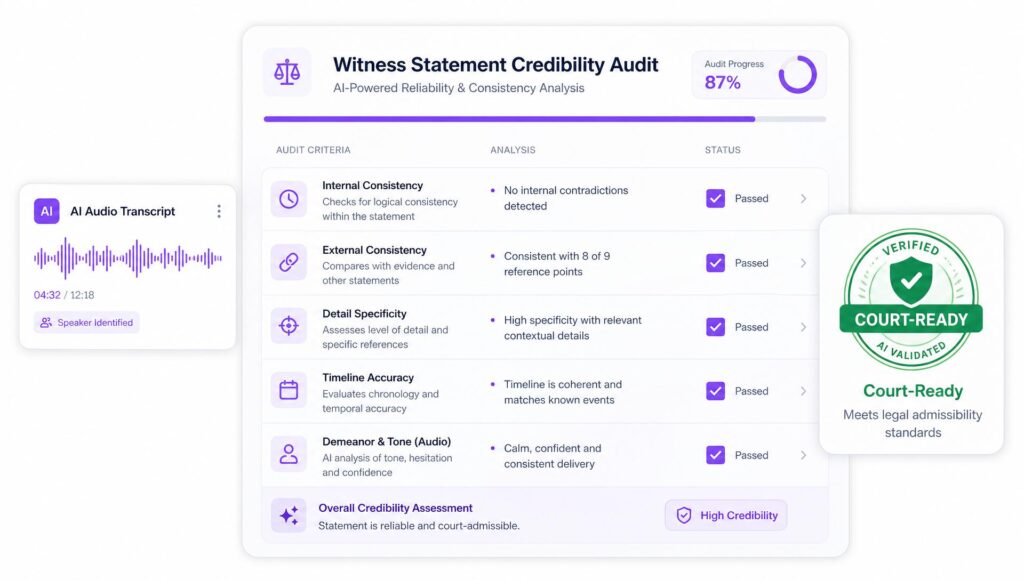
Quick Credibility Audit , Before You Submit:
- ☐ Is every time reference specific (not "later" or "shortly after")?
- ☐ Have I separated what I observed from what I concluded?
- ☐ Have I shown my inference chains (so conclusions look logical, not invented)?
- ☐ Have I disclosed my position in the case and any potential bias?
- ☐ Have I explained how I could see/hear clearly (distance, lighting, obstacles)?
- ☐ Are exhibits integrated into the narrative, not just listed?
- ☐ Does the closing declaration use the correct jurisdiction-specific perjury language?
- ☐ Is the declaration signed, dated, and located?
Automating Your Account: Transcription as Credibility
If you're recording witness interviews or documenting your own account, consider using a witness statement transcript service to create a detailed, time-stamped record. This serves two purposes: it locks in your memory while fresh, and it creates a record you can reference when drafting the formal statement.
VideoTranscriber can help convert recorded statements into documented transcripts, which then become exhibits proving you reported details consistently from day one.
The Bottom Line
A witness statement that holds up isn't about being perfectly neutral. It's about being strategically transparent. Show your work. Admit what you don't know. Disclose your position. Build logical inference chains that opposing counsel can't break.
When you write this way, judges see honesty. Adjusters see credibility. And your statement becomes the kind of evidence that changes outcomes.
Start writing within 24 hours of the incident. Use this framework. Review it with the credibility audit. Then submit it knowing you've built something that will survive scrutiny.
Your credibility is your case. Make it count.
Frequently Asked Questions (FAQ)
What if I only saw part of the incident, like the aftermath?
Write exactly what you saw, and nothing more. This falls under the "High Confidence With Honest Limitations" tier discussed above. For example, instead of guessing how a crash happened, state: "I heard a loud crash at 2:45 PM and turned around to see..." Your testimony about the aftermath (such as the final position of vehicles or the demeanor of drivers) is still highly valuable when restricted to pure, undeniable observation.
How long should a witness statement be?
There is no legal word count requirement. A strong statement is often just 1 to 2 pages. It should be exactly as long as needed to establish the "Before-During-After" timeline and anchor your specific details (times, locations, sensory data). Do not pad the word count with repetition or personal opinions, brevity built on solid facts is your best asset.
Should I include what other witnesses told me at the scene?
Generally, no. What others tell you is considered hearsay and is one of the quickest ways to trigger the "Mixing Observation With Opinion" trap. Stick exclusively to what you personally saw, heard, and felt. If another witness shared something important, you can simply note: "Another bystander, who identified himself as John, was also present," and let the investigators collect John's statement directly.
Can I change my witness statement later if I remember something else?
It is very difficult to alter a submitted and signed statement without damaging your credibility (refer back to the "Too Perfect Memory" trap). This is why it's critical to lock in your memories within the first 24 hours. If you must add information later, it typically requires a supplementary statement, which defense attorneys will naturally scrutinize.
Does my statement need to be typed or handwritten?
While handwritten statements are accepted at the scene, formal typed statements are strongly preferred by courts and adjusters because they eliminate handwriting misinterpretations. If you recorded a voice memo or video at the scene to capture fresh memories, using a witness statement transcript tool to generate a clean, timestamped transcript is the most reliable way to transition your raw, accurate memories into a structured, typed draft without losing critical details.
Legal Disclaimer: This article is provided for general informational and educational purposes only. It does not constitute legal advice and does not create an attorney-client relationship. Laws, procedural rules, and declaration requirements vary by jurisdiction and may change over time. For guidance specific to your situation, including the correct closing language for your jurisdiction's perjury statute, please consult a licensed attorney in your area.